
Become a supporter
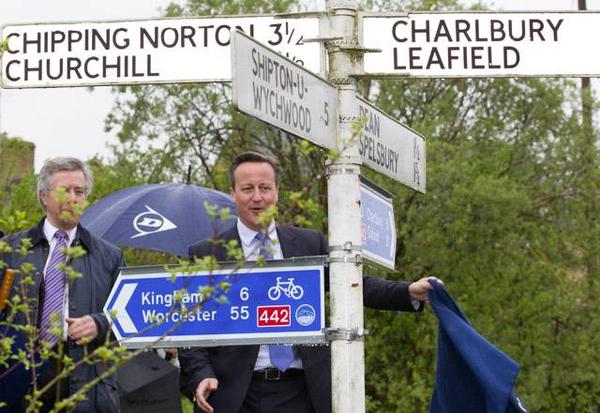
Prime Minister David Cameron braved downpours on Friday to open the latest addition to the National Cycle Network, the Cotswold Line Cycle Route.
The 77-mile route runs from Oxford to Worcester on quiet lanes and traffic-free paths, in parallel with the rural railway known as the Cotswold Line – and travelling right through the heartland of the so-called ‘Chipping Norton Set’.
Unveiling a trademark National Cycle Network sign pointing the way to Oxford and Worcester, as well as nearby stations at Charlbury and Kingham, the Prime Minister described the National Cycle Network as a “national treasure” and said that this latest addition was a “delightful route” – describing how it follows roads that he regularly cycles with his family. Asked if Boris Johnson might also enjoy the route, he replied “I think it might be a bit hilly for Boris”.
The launch took place in the village of Chadlington, a few miles from David Cameron’s constituency home. Local Sustrans volunteers and cyclists crammed around the village green and the popular, bike-friendly Café de la Post to hear speeches from the Prime Minister and Sustrans chief executive Malcolm Shepherd.
The route was devised and signposted by local volunteers, with funding from the Cotswolds Conservation Board (which looks after the Cotswolds Area of Outstanding Natural Beauty), train company First Great Western, and local charity Charlbury & Overseas Community Projects – the grant-giving arm of the Charlbury Beer Festival.
The funding covered signposting between Hanborough and Honeybourne stations. Evesham to Worcester had already been opened by Worcestershire County Council, leaving two short sections (Oxford to Hanborough, and Honeybourne to Evesham) currently unsignposted.
Here at cycle.travel we’re particularly delighted to see the route opened, as we’ve been involved in its creation and it runs directly past our base in Charlbury, Oxfordshire – wave as you pass by!
Follow our full route guide to the Cotswold Line Cycle Route.
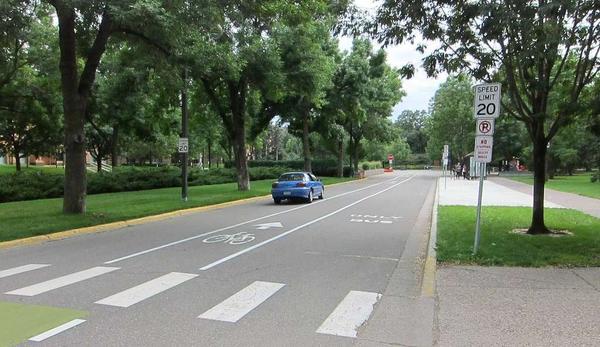
Cyclists have long believed that building bike lanes doesn’t cause car congestion – and now there are figures to back this up.
Famed data journalism site FiveThirtyEight, whose founder Nate Silver is famed for accurately predicting the results of US presidential elections, looked at traffic flows in Minneapolis before and after bike lanes were installed. The Minnesota city vies with Portland, Oregon for the title of “cycling capital of America”.
Using official traffic data, they examined 10 roads where a bike lane has replaced a car lane, and measured the “volume-to-capacity” ratio. As they explain:
“We take an estimate of the number of cars traveling in the busiest direction during peak travel time, and divide this by each road’s capacity. This gives us what traffic engineers call the volume-to-capacity ratio, or V/C ratio. This metric tells us how ‘full’ each road is.
“As the V/C ratio approaches 1, the amount of congestion increases. At V/C ratios between 0.5 and 0.75 you have mild to moderate congestion, where traffic is still moving smoothly but you might notice that it’s a bit harder to move from one lane to another. At V/C ratios between 0.75 and 0.9 you experience heavy congestion and the effect on your commute is greater. Here, traffic starts to slow down and minor incidents can cause jams. Severe congestion occurs at V/C ratios above 0.9.”
The results were startling. Of the ten streets, only one road (19th Avenue S) had free-flowing traffic before the bike lanes were painted, but “mild to moderate congestion” afterwards. Its 0.62 score was still comfortably within the “moving smoothly” category. But eight others remained comfortably below 0.5, with the last just at the border.
FiveThirtyEight’s authors, Gretchen Johnson and Aaron Johnson, say that the trick is to choose roads that are already running below capacity:
“Bike lanes don’t cause a lot more congestion if you put them on the right streets. If you cut down the size of streets that are already near capacity, you’ll create severe congestion. But if you start with roads that are well under capacity, you’ll only increase the congestion a little bit. And it may not even be noticeable. Slimming down these roads that are too “fat” is known as a road diet — and yes, that is the technical term.”
They don’t believe this is an isolated occurrence. In New York, where new bike lanes have attracted significant controversy, the same pattern was observed. Two busy junctions were still largely uncongested after the bike lane was installed, just shading above 0.5 in the rush hour.
More to the point, not only did car drivers enjoy a similar journey time to previously, but other users benefited greatly. “The number of cyclists using the road went up, and speeding cars, cyclists riding on the sidewalk and injury-causing accidents went down. The road diet isn’t just creating a space for bikers; it’s also making the street safer for other types of users.”

Cycling might be booming in the UK – but we’ve a long way to go before we can aspire to European levels.
That’s the message from a new survey commissioned by bike company Jyrobike, who build ‘auto-balance bicycles’ for anxious cyclists. They found that 35% of adults haven’t cycled in the last decade, and that 28% haven’t ridden a bike at all since childhood.
Safety and fear of traffic were the reasons most frequently cited for not cycling. The survey revealed a sharp gender divide: 34% of women hadn’t ridden a bike since they were kids, vs 21% of men.
Robert Bodill from Jyrobike said:
“We wanted to get an understanding of Brits’ cycling habits away from the glitz and glamour of road races and the track and talk to ordinary people of all ages, regions and abilities. Most people don’t think of themselves as a cyclist, but the truth is, if you have ridden a bike in the last five years you are. We were really surprised with the findings.
“Riding a bicycle is one of the most exhilarating things we do as kids and it’s a real shame that one in four of us haven’t got back on a bike since we were children. A lack of balance is one of the main obstacles to more Brits cycling, and that’s something we’re working to address at Jyrobike with the launch of our new Auto Balance Bicycle that uses patented gyroscopic technology to teach kids how to ride in a single afternoon and helps adults ride for longer.”
The Jyrobike works via a a battery-powered, rechargeable, motor-driven ‘Control Hub’ that drives a spinning flywheel. When turned on it acts like a gyroscope or gyro and provides a stabilising force, working just as gyros do to keep helicopters stable in the air, boats stable at sea and spaceships stable in orbit. The result is an Auto Balance Bicycle that keeps riders upright and stable, even when a rider starts to tip or wobble. Jyrobike will launch globally via a Kickstarter campaign in June 2014.
See the full infographic on the survey findings.
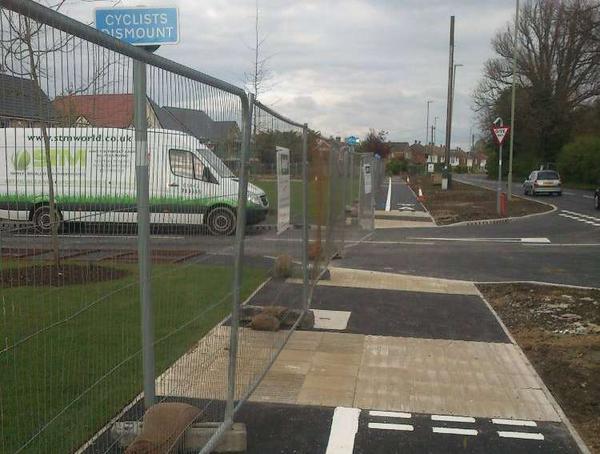
Cyclists in Didcot have slammed a new cycle path for poor-quality provision.
The path on Wantage Road links to a new development at the Great Western Park, built by Taylor Wimpey. But the local cycle campaign HarBUG, the Harwell Bicycle Users’ Group, has identified a litany of problems with it even before it initially opens. They include:
HarBUG say that this type of path would be better off not built.
“We have seen that this type of cycle lane causes more problems for cyclists. It is not much use for cycle commuters to Harwell village or the Campus. Some motorists seem to think cyclists must use cycle lanes if they are provided – and will let you know about it.”
Citing assurances from the developers that the new estate roads would be safe for cyclists, they ask why there are so many instructions to dismount when entering them. HarBUG are now contacting Taylor Wimpey and Oxfordshire County Council to discuss the situation.
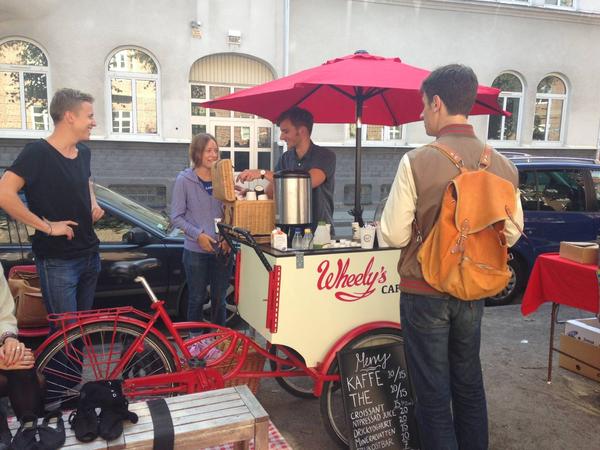
A group of Swedish entrepreneurs is aiming to create a worldwide coffee company – entirely through pedal power.
Wheely’s Café is a network of two-wheeled coffee carts which come ready equipped with “everything to sell coffee, tea, soft drinks and pastry”. Now, the Swedish company is looking for wannabe bike baristas to take the franchise worldwide.
For $2,500, you get a Wheely’s bike with a parasol, thermos flasks for coffee, solar-powered battery unit, pastry display units, sink, gas stove and storage – plus “a lot of small ingenious details, like a small loudspeaker to play the happy morning music”. The bike has been developed by NSID, “the Nordic Society for Invention and Discovery”.
Wheely’s also grant you a lifetime license for the brand, and rights to it within a certain area. They claim that the bike will quickly pay for itself in urban areas:
“Our tests show a daily profit of between $150 - $300 from our Wheely’s testing in Sweden, great revenue that goes hand in hand with great fun, not to mention the health benefits. Of course, most of the selling will be done in the rush hours. You can expand that money quite a lot by selling lunch / salads / sandwiches. If you have a spot in central London / New York / Tokyo you can probably put a zero after our estimates.
“You will be part of a global network of Wheely’s owners, getting a great bike, keeping fit and being ecological. In short: Making the world better, one pedal at a time!”
The company pitches itself as the anti-Starbucks – using the methods of the big chains to empower local businesses. “You could say we use their own weapons against them, only Wheely’s is nimbler, smaller and faster moving.” They aim to be present in 100 cities within a year.
The project is being funded by IndieGogo, a Kickstarter-like platform where cheaper prices are available to those who sign up first. You can find out more on the project page.


Made in the Cotswolds. Published by Éditions Système D Ltd.
Log in with your cycle.travel account:
| Password |
Or simply use your account on:

