
Become a supporter
Scotland’s own Coast-to-Coast cycle route has moved a step closer, with the thumbs-up for a railway path to bypass a dangerous stretch of road.
The path, west of Peebles, will pass through a disused tunnel and over a historic viaduct to avoid the busy A72 road. The railway east of the town has already been converted into a cycle path by the Upper Tweed Railway Paths group, which is also promoting this latest section. When completed, the path will link with quiet roads at either end.
In particular, it will form part of the new ‘Scottish C2C’, a 111-mile route from the Solway Firth to Edinburgh devised by Sustrans founder John Grimshaw and experienced bike route surveyor David Gray. They describe the proposed new path as “the most valuable section of all because it bypasses the winding main road, on which a cyclist was killed in 2006”.
At a planning meeting on Monday, local councillors approved the scheme to create a cycleway between Peebles and Lyne Station, where the route will pass onto minor roads. According to the Southern Reporter, planning officer Derek Inglis noted:
“This is a good news story. The A72 for cyclists, particularly west of Peebles, is treacherous.”
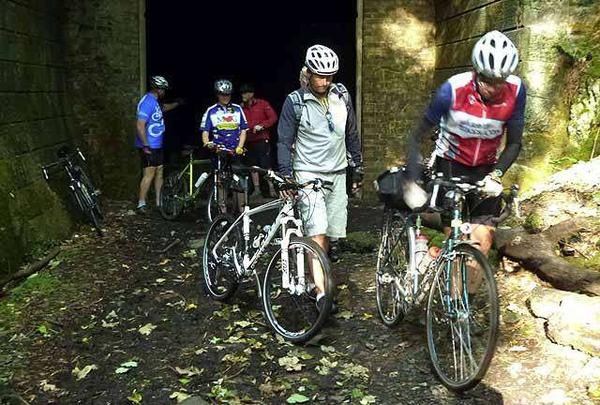
Neidpath Tunnel and Viaduct will form the centrepiece of the new route. The tunnel has already been surveyed by local cyclists (pictured) but will require a bat licence before it can be opened to the public.
Future work is likely to focus on providing an alternative to the next section of road going south, the B712.
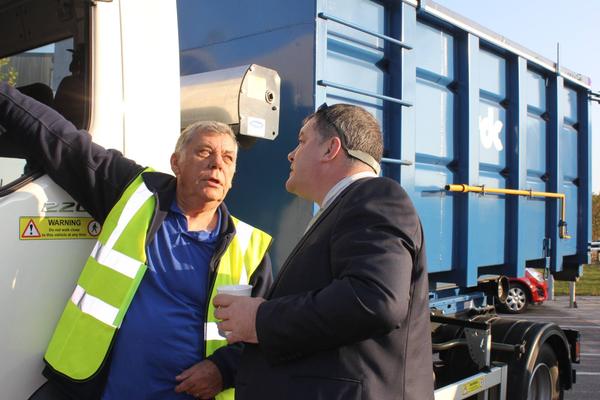
Cambridge University is taking a stand by requiring HGVs to be fitted with bike safety features – the first organisation outside London to do so.
The University is planning extensive development around the city in the next few years, and anticipates heavy construction traffic as a result. It has asked all its contractors to sign up to a new Cambridge Construction Logistics and Cycle Safety initiative, along the lines of the scheme operated by Transport for London. Among the requirements are:
The initiative will run as a voluntary scheme for one year. From then on, it will become compulsory in new contracts – with penalties for non-compliance.
Ravinder Dhillon, Head of Estate Development at the university, said:
“We saw what was happening in London and, as many of our staff cycle to work, the benefits were obvious to us. With almost £2 billion of construction work planned by the University in the next five to ten years, the issue of how HGVs interact with pedestrians and cyclists is of growing importance. The city will become one of the biggest construction hubs in the UK outside of London. We want our construction contractors to know what we want and what we expect.
“We are delighted the contractors have reacted so positively to this and we will monitor its progress over the next year in the lead up to it becoming a compulsory scheme with sanctions.”
Current large university developments city include the West Cambridge site, North West Cambridge and the Cambridge Biomedical Campus. With many of the same contractors working on university and non-university projects, it is hoped that the scheme will help to improve standards in other works taking place around the city.
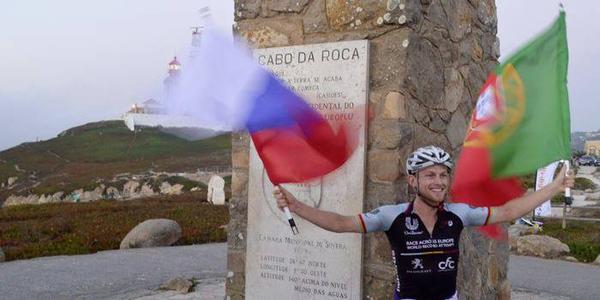
There’s a new world record in cycling – and we’re not talking about a measly 1km round a track, but the near-4,000 miles across Europe.
James Bowtell and his ‘Velo7’ team set out from Ufa, Russia, on 27th July, and arrived at Cabo da Roca in Portugal on 1st September – averaging 105 miles per day over 37 days. The two points are commonly considered the most easterly and westerly points in mainland Europe.
This is believed to be the first attempt at setting such a record, due to the logistical complexity of the challenge and the extensive mileage involved. Before departing from the UK, James was told by a representative of the Russian Cycle Touring Club that the event would not be possible. The route crossed seven European countries: Russia, Belarus, Poland, Germany, France, Spain and Portugal.
James was the only cyclist, he had built a strong support team consisting of fellow university undergraduates and graduates to assist in the pursuit of this unique world record. Commenting on the challenge, he said:
“It’s been exhilarating, exhausting yet one of the most rewarding experiences of my life. I can safely say it was worth the severe fatigue, my knee injuries and the hellish conditions to cross the finish line with my team, in the knowledge that we have set a world record and raised funds for our chosen charity Cyclists Fighting Cancer.”
During the challenge, the team had to overcome some testing obstacles in order to finish within the record time. In Russia, James developed patella tendinitis in his right knee, aggravated by the appalling condition of some of the roads. As a result of the total mileage and the inclines of the Pyrenees, James then suffered from ligament damage, an injury that could have brought the race to a halt and one that limited his ability to pedal with his left leg.
The team secured significant corporate support for the event, particularly from the main sponsors Halfords, Peugeot and Unilever. At the time of crossing the finish line the total amount raised was over £16,000.
You can find out more at velo7worldrecord.com.
Wiltshire, Cheshire and Lancashire have one. Avon has one, despite not even being a county any more. But Oxfordshire no longer has a county cycleway.
There was a brief vogue in the late ’80s, I think, for these – circular on-road routes that generally looped around the edge of the county. Oxfordshire’s was officially withdrawn around 2005 due to rising traffic levels on certain parts of the route; rather than actually making conditions better for cyclists, the County Council decided to cancel the route entirely. (Contrast with Cumbria, where the Cumbria Cycleway was put in abeyance for the same reason, but is now being revived with Local Sustainable Transport Fund money.)
There’s certainly some truth in this. The route over Newbridge, for example, is highly unpleasant on a bike. The staggered A40 crossing east of Burford isn’t fun at all. But both of these could have been fixed at relatively minor outlay.
Even now, you can still see Oxfordshire Cycleway signs here and there: there’s a modern one on the road from Charlbury to Burford, which I think was put up after the route was cancelled, and a number of more-or-less decrepit ones poking out of hedges. But piecing them together into a navigable route isn’t easy.
Anyway, yesterday in a second-hand bookshop in Oxford I found, for the princely sum of 50p, the official route map from 1980something. (Or, at least, pre-1995, as all the phone numbers are missing the 1 after the initial zero.) So here it is: the main circular route, and the east-west route confusingly marketed as the Windrush Valley Cycle Route even though half of it is nowhere near the Windrush.
There’s a small amount of coincidence with today’s National Cycle Network, but for the most part it’s independent. The route in the north-west of the county (say, Cropredy to Kingham) is particularly lovely and I could perhaps be tempted by an afternoon jaunt…

The Government’s much-heralded £12m fund for cycling in National Parks is running into trouble – with one National Park almost entirely rewriting its plans, and concern that two others may not be able to carry theirs out.
In January 2013, the then Cycling Minister Norman Baker announced that funding would be available to improve cycling in three cities and several National Parks, leaving other rural areas and towns in the cold.
Cycling organisations had privately expressed concern to Government that the National Parks may not be able to prepare workable plans in the tight schedule, and suggested that other countryside areas should be eligible – such as Areas of Outstanding Natural Beauty.
However, in August that year, the Government pressed ahead with the project, awarding the money to the New Forest, Dartmoor, the Peak District and the South Downs.
The New Forest project was the first to run into trouble, with its decision to cancel the proposed cycle hire scheme widely condemned by cycling campaigners. Now, an investigation by trade magazine Local Transport Today has shown that the rest of the project is being rewritten, despite the New Forest National Park Authority’s promise that it had been “carefully designed to be deliverable” by the March 2015 deadline.
In fact, Local Transport Today has found that the £1.6m family cycle centre in Brockenhurst is at risk after a private sector partner pulled out, with a New Forest spokeswoman saying:
“The commercial partner has now decided not to proceed with their project. As part of the programme review, we are currently assessing other ways to deliver the family cycle centre.”
A third scheme was for a £500,000 network of ‘pedal buses’, super-rickshaws which would each carry up to eight passengers and would be partly powered by passengers. The buses were due to enter service this year – but legal problems threw a spanner in the works. Now, it looks likely that they will be restricted to private land if they enter service at all:
“Following further feasibility work which identified the legal and operational challenges of implementing the pedal bus project on highways, we are investigating delivering the project on private land through our grants scheme.”
The New Forest programme may now be entirely redrawn to focus on improving local cycle routes.
Meanwhile, there is concern that the cycling plans of two other National Parks are at risk.
In the South Downs, the National Park Authority is planning a new route along the Ouse Valley – a project warmly welcomed by local cyclists. As the local Argus newspaper reports, however, the path promoters have not yet secured the agreement of all the landowners along the route.
The agreements need to be in place, and work underway, by the same March 2015 deadline if the £600,000 of Government funds are to be claimed. Andy Lock, from Cycle Seahaven, described the task of balancing landowner wishes and funding requirements as a “tricky job”.
In the Peak District, where an ambitious network of traffic-free paths is proposed, local Sustrans rangers have appealed for help in securing approval for the Bakewell-Matlock route – permission for which was previously rejected. Clyde Hinton writes:
“A planning application made by Peak Cycle Links and John Grimshaw, to open precisely this path, failed a couple of years ago mainly due to protests coming from certain quarters in our local area. It is imperative that you give your support to this project.”
You can express your support using an online survey set up by Derbyshire County Council.


Made in the Cotswolds. Published by Éditions Système D Ltd.
Log in with your cycle.travel account:
| Password |
Or simply use your account on:
