
Become a supporter
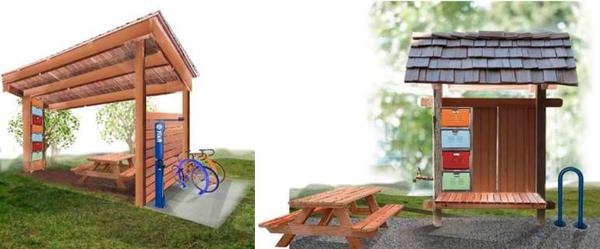
The bike-friendly US state of Oregon, home of America’s cycling capital Portland, is to build a network of ‘bike pods’ along its most popular cycle routes.
But with a nod to Scottish hikers, we’d rather call them bike bothies. The wooden huts will be built on long-distance routes like the Oregon Coast Bike Route and the TransAmerica Trail. There’ll be two types: overnight ‘pods’ and daytime ‘hubs’. The State Parks Department explains it further:
“The deluxe overnight ‘Bike Pods’ will be constructed to serve the long distance touring cyclist, while the day use ‘Bike Hubs’ will be constructed to best serve the needs of the day use cyclist whether for recreation or cycling. All Pods and Hubs will feature bike parking, seating, maps and/or interpretive information, and shelter. All hubs will also be equipped with a bike-repair station that will include a bike stand, tools, and an air pump.”
Other facilities will include food storage, water taps, secure lockers, and electrical outlets for recharging phones, and secure lockers. The State Parks already have several dedicated ‘hiker-biker’ campsites, where spaces are reserved for people arriving on foot or by bike, not by car.
The scheme is firmly targeting the spending power of the travelling cyclist, with many of the hubs being built in urban locations.
“Specific ‘Bike Hubs’ are strategically located within communities to bolster the connections between bike routes and local businesses. By providing amenities in town cyclists are encourages to stay and explore the local communities. These hubs will allow local communities to welcome bicycle tourists to capitalise on the recreation lands that surround them and benefit economically from cycle tourism. Many of the targeted locations for Pods and Hubs are within economically depressed counties, hard hit by both recession and the long and difficult transition from resource extraction industries to other viable sources of employment.”
The promoters are now bidding for Lottery funding to cover most of the $435,000 cost. Rather endearingly, the bid includes a letter of support from a local microbrewery, who point out:
“Cyclists spend money at local businesses, especially breweries.”
Could the idea take off in Britain? We’d love to see these on the National Cycle Network’s challenge routes.
Via BikePortland.
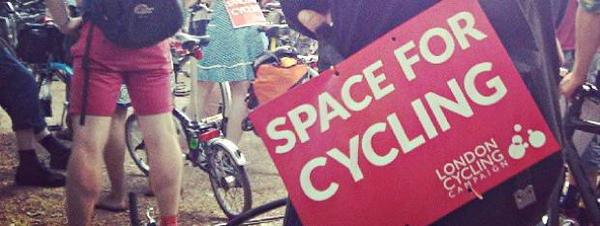
London’s Space For Cycling campaign, which calls for segregated cycling facilities on main roads, is to be launched nationally in April.
And to make sure local councils have no more excuses for bad cyclepaths, the new campaign will be producing a ‘Councillor’s Guide to Good Design’.
The campaign, which began last summer, demands “protected space” on main roads and traffic-calming on minor roads. By providing a single message which London’s disparate cycling community can rally behind, it has started to influence road planners to give cyclists a better deal.
Now, national cycling charity CTC and local campaign groups are to roll the message out nationwide – starting in mid-April, and with a campaigners’ conference in May. As CTC explains:
“The campaign is calling on councils across the country to make our streets and roads safe and inviting for everyone to cycle - focusing specifically on infrastructure and design standards. We’ll be launching a ‘Councillors’ Guide to Good Design’ along with online mapping tools to showcase good and bad spaces for cycling and a quick and easy 'email-a-councillor' tool for local groups.”
CTC says that groups in Leeds, Manchester, Sheffield, Birmingham, and Newcastle have already signed up.
The conference, to be held in Leeds on 3 May, will cover:
You can sign up on the CTC website.
The national rollout has been funded by the bike trade via the Bike Hub lobby scheme.
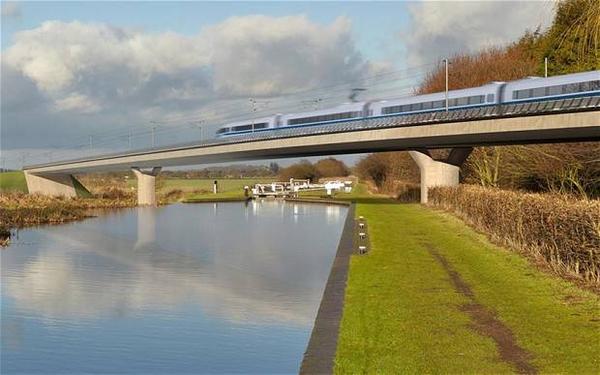
cycle.travel has obtained details of the new National Cycleway being planned beside the HS2 railway, from London to Birmingham and the North.
The Dutch consultancy firm drawing up the proposals has promised “world class standards, building on existing best practices including the Dutch Standards”. And with HS2 calling at many of Britain’s large cities, they say city cycling could particularly benefit.
The route will not be directly beside the railway, but is being developed as a separate “though parallel” project. But the designers aim to stay within 3 miles of HS2 where possible.
If HS2 is not a certainty, this cycleway is even less so. No funding has yet been earmarked, and the Government will not receive the report until this autumn – at which point it could be buried in pre-election politics.
But with talk of for a “world class route”, it has the potential to be Britain’s biggest cycling project yet. There’s certainly no shortage of ambition. The route aims to cater for every kind of journey: “the short everyday trip within a local community, the trip to school, or station, or shops, or work, everyday casual recreation, local cycling trips for leisure, to connect people with their surrounding countryside and longer touring trips.”
Starting at Euston, HS2 heads out through West London to the Chilterns. Its ‘arms’ will then run to Birmingham, Manchester, Sheffield and Leeds, plus an intermediate station between Derby and Nottingham.
But the HS2 cycleway could call in at more towns along the way, either by diverting the main route, or by providing ‘spurs’. Chesterfield, Mansfield, Stoke-on-Trent and even little Buckingham have all been suggested as towns which could be included.
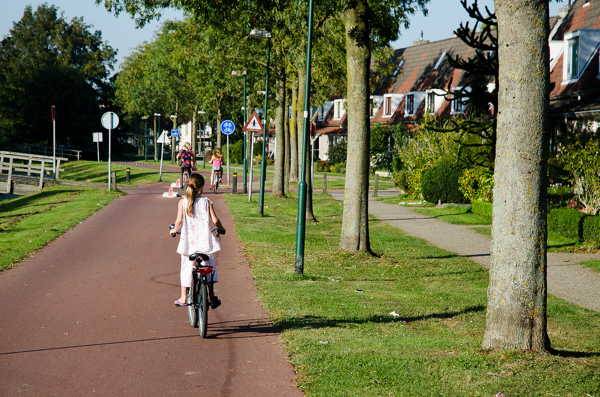
Royal Haskoning DHV, the Dutch firm working on the project, plans “a really high quality urban route including all the best practices of redefining road space, revising markings, giving priority to pedestrians and cyclists and so forth”. Where possible, the cycleway will link with other local routes, such as London’s proposed Quietways and Cycle Superhighways.
The designers have also suggested that it could help to push existing cycle projects forwards – in London, for example, “better access for cycling through parks and between major stations such as Paddington to Euston”.
(Picture: Dutch cycling, Jarrett M – Creative Commons attribution licence.)
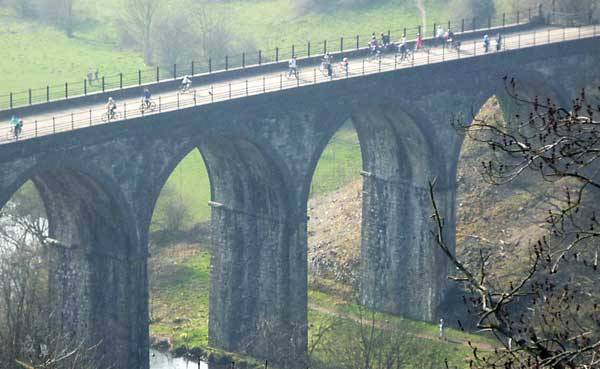
Most of HS2, however, will run through the countryside – as the controversy over its route through the Chilterns shows. In these areas, the new cycleway is more likely to follow minor roads (with traffic calming) and trails rather than new construction.
But the designers think that the new route could tempt many rural residents onto their bikes. “By linking smaller villages to towns, [locals] could, for the first time, cycle on safe, attractive, traffic segregated and continuous routes. These would also provide better recreational routes.”
One particular area of focus is the Peak District. Though the two arms of HS2 go either side of the Peak District – one to Manchester, one to Leeds – the National Park authority is keen to attract more tourists without cars. Several new traffic-free routes are already being built in the area, and the HS2 cycleway is keen to link up with them – providing through-routes from Stoke, Sheffield, Derby and Manchester.
(Picture: Headstone Viaduct in the Peak District, Duncan Hull – Creative Commons attribution licence.)
As might be expected from consultants based in the Netherlands, the inspiration for the HS2 cycleway is firmly Dutch:
“Our brief is to define ‘world class standards’ which we anticipate will entail building on existing best practices including the Dutch Standards, as set out in their CROW design guides, so as to create a route of the highest quality and one likely to be as popular as possible, successfully persuading the UK public currently not cycling and international tourists visiting England that cycling is a viable option.
“In some cases, this may involve introducing standards and practices not yet common in the UK. The Department for Transport wishes this to demonstrate best practice for future cycle infrastructure design, where cycling can be mainstreamed as a form of mass transit in cities, and as a viable form of access to rural areas from railheads.”
Though Royal Haskoning hope to reuse existing roads and greenways where possible – “if adequate segregation or traffic calming could be put in place to attract non cyclists” – they recognise some land purchase will inevitably be required to build a high-quality route.
The HS2 railway is a a long-term project. Construction isn’t due to start until 2017, and the first trains will reach Birmingham in 2026. Leeds and Manchester will have to wait to 2033.
The cycleway is being constructed separately, but no timeline has yet been announced. Royal Haskoning intend to submit their outline report to the Department for Transport this autumn. If the Government approves, more detailed studies can then take place on the exact route. Meanwhile, workshops are being held to gather ideas and “aspirations” from local councils and cycling groups.
For cycling campaigners, the challenge is to make sure that the vision of a “world class route” is maintained – and not diluted to keep costs down.
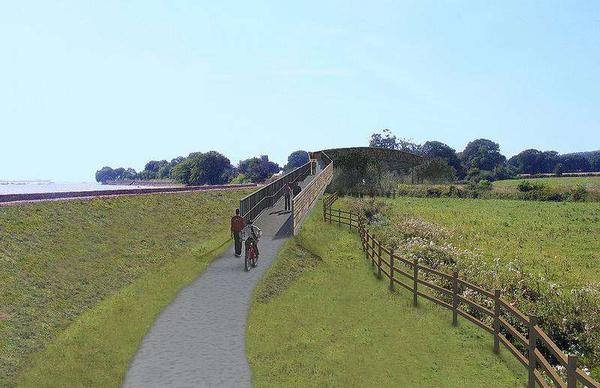
It’s not just trains that get to experience the stunning – and wind-swept – Dawlish coast in Devon. The spectacular spot, still closed to trains after February’s storms, will soon be accessible via a brand new cycle route.
The largely traffic-free Exe Estuary Trail follows the River Exe from Exeter, turning onto the coast at Dawlish Warren. But a mile-long stretch beside Turf Lock and Powderham has been missing for several years.
Now, Devon County Council is spending £1.6m to build a 3m-wide off-road cycle path, passing through an extremely ecologically sensitive area. The route follows the estuary flood banks, with viewing areas giving stunning views of the Exe Estuary.
A new bridge will take the trail over the Paddington to Penzance main railway line near the existing level crossing at Powderham, before joining a quiet lane for the journey down to Starcross.
Stuart Hughes, Devon County Council’s cycling councillor, said:
“This last piece of the jigsaw may have been a long time coming but it will certainly have been worth the wait once the trail is complete. The Exe Estuary Trail highlights why we’re a cycling county and there’s no doubt it will be a flagship route for our county. It has become one of the best ways to enjoy the spectacular views offered by the Exe Estuary. The Trail is attracting people to explore the area, which is good for local business, but it’s there for local people to enjoy as much as visitors. It provides communities along the route with the opportunity to cycle or walk on their journey to work or school as well as in their leisure time.”
The new bridge has aroused some local concern, with original plans for curved approach ramps being replaced with straight-up approaches. Work is expected to be completed by late September 2014.
A ferry runs between Starcross and Exmouth on the other side of the Exe, offering the tantalising option of a 16-mile circular, traffic-free route around the estuary.
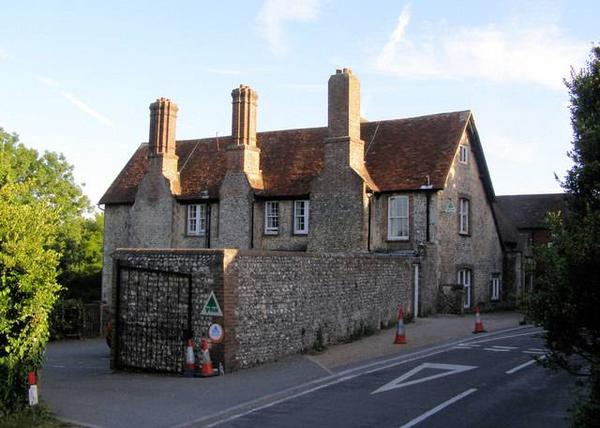
cycle.travel has learned that the Youth Hostels Association is to close seven hostels this year – including several that have served holidaying cyclists for generations.
The YHA has cut back its rural hostel network over the last 20 years, but the latest batch of closures will be particularly keenly felt. They are:
The hostels are expected to close in autumn 2014.
In an internal email, YHA says:
“It has been decided that it is necessary to close some of our hostels. This decision has not been taken lightly and is no reflection on the excellent customer care and support from staff and volunteers. The Board of Trustees explored all possible options for the hostels concerned and based their decision on the running costs, locations, investment needed and predicted future financial return.”
In the last year, the YHA has unveiled a £5m hostel in Lewes on the South Downs. A hostel has also opened at Pinkery on Exmoor, at the National Park’s existing outdoor education centre. The Association says “All income gained from the sale of hostels is used to invest directly into current hostels or open new hostels.”
The YHA has held out the possibility that the seven hostels could continue under independent ownership, affiliated to the YHA through its ‘Enterprise’ scheme.


Made in the Cotswolds. Published by Éditions Système D Ltd.
Log in with your cycle.travel account:
| Password |
Or simply use your account on:
