
Become a supporter
The Concorde Way gets its name from the supersonic airliner that was built in Filton and, fittingly, landed here after its final voyage. The cycle route, a collection of traffic-free paths and minor roads, is rather less speedy; that said, it provides a safe cycling alternative to the A38 and its ceaseless traffic lights.
The paths are generally of good quality, though the subways under the motorway junction are rudimentary. The route passes Filton Abbey Wood station for combined bike/rail journeys.

Getting into town from Long Ashton is both easy and picturesque thanks to the new Festival Way cycle route, through the heart of Ashton Court. It is a little hilly, though, and you may choose to follow the cyclepath along Ashton Road and Brunel Way before rejoining the route by the playing fields. A disused railway bridge then takes you across the Avon, from where the riverside path leads to Harbourside.
Signposted as National Cycle Network routes 33, this route actually continues all the way out to Flax Bourton and Nailsea, making it a feasible option for medium-distance commuters.
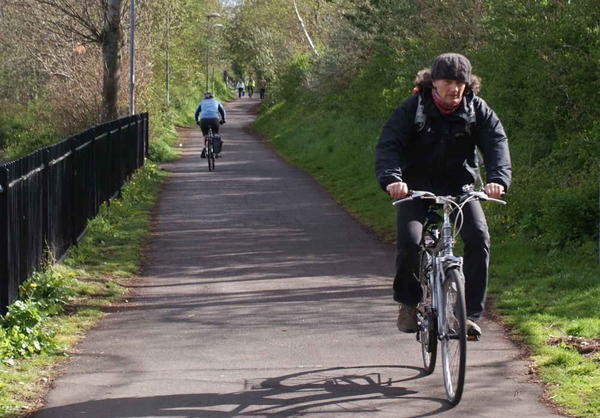
The Bristol–Bath Railway Path is possibly Britain’s finest urban bike route and certainly Bristol’s. It’s flat, uninterrupted tarmac (save the very occasional road crossing) all the way to the ring road, from where it makes its way to Temple Meads and the city centre on small roads and cycle paths. The route is genuinely very busy throughout the day, but particularly at commuter times: take care and watch your speed.
The path is easily accessible from places like Staple Hill and Fishponds via the road network. There are also a few dedicated cycleway links, notably from Mangotsfield.
Social enterprises have long thrived in Bristol, and several cycling organisations are run on a non-profit basis. There’s the Bristol Bike Project, which repairs and recycles old bikes, and Life Cycle UK, which provides free cycle training for locals. The delightful quarterly Boneshaker magazine, written by local cyclists, sums up the prevailing attitude: “it's not how much your bike weighs that matters, but where it takes you”.
One other non-profit is the city’s new cycle café, Roll for the Soul. Located just off Quay Street, it offers coffee and sandwiches, beer and spanners – what else could a cyclist need? There’s also a ‘hub’ event space for local cycling groups to use.
And famously, the biggest cycling charity of all is based in Bristol. Sustrans started as a local cycling campaign and has since blossomed to run a nationwide network of bike routes, but it’s still very active in the area. One of its founders, George Ferguson, is now the (cycling) mayor of Bristol.
The local campaigning role has been taken up by the Bristol Cycle Campaign, which tirelessly fights for safer routes in the city. It recently launched a ‘Bristol Cycling Manifesto’, which aims to raise cycling to 20% of city travel by 2025. There’s also a monthly Critical Mass ride.
You’ll see all manner of bikes around the city. The terrain is unforgiving (though kinder than Bath’s!), and that makes low-geared hybrids and lightweight drop-bar bikes particularly practical. But Dutch bikes, fixies, tandems and that-old-thing-from-the-back-of-the-shed are all common sights.
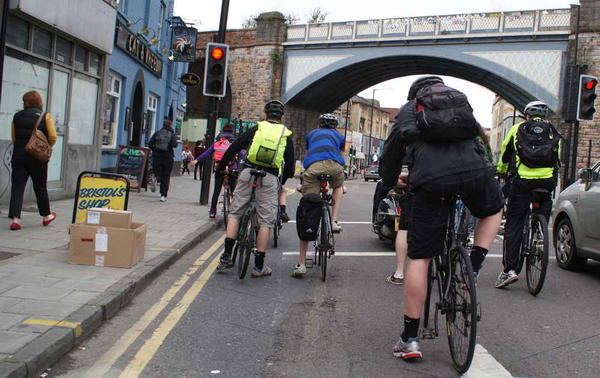
Bristol’s major roads are largely untamed. Many have partial cycle lanes, usually shared with buses, but the sheer weight of traffic in this dense city never makes for a relaxing ride.
Fortunately, you’re not alone: thousands of cyclists take to these roads every day. At rush hour, Stoke’s Croft, Cheltenham Road and Gloucester Road are a tidal wave of bikes, advancing light by light up the hill. Though cyclists can use the bus lane, car parking is permitted in it for most of the day – so you may end up dodging in and out more than you’d like. (This, surely, is one road where a segregated cycle track would make a huge difference.)
It’s a similar story on the climb up to Clifton, through College Green and Park Street. Cars and buses dart in and out as cyclists labour up the hill. It’s often possible to string together a back-street route, but Bristol drivers know the rat-runs too; what looks like a neat alternative on the map may not work in the flesh.
In the city centre, much to Bristol’s credit, cycling on the pedestrianised streets is generally permitted. Cycle contraflows on one-way streets are common. All of this helps to avoid the Inner Ring Road, which is no place for a bike – though you’ll invariably need to cross it at some point. (The Bristol Cycling Campaign has proposed a traffic-free ‘Inner Loop’ to provide a safer option.)


Made in the Cotswolds. Published by Éditions Système D Ltd.
Log in with your cycle.travel account:
| Password |
Or simply use your account on:
