
Become a supporter
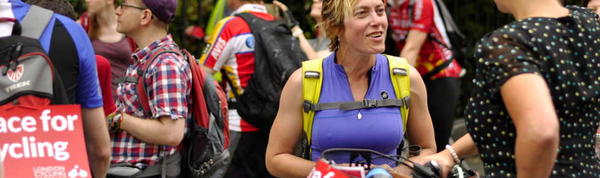
With over 10,000 members, the London Cycling Campaign is easily Britain's biggest. It has the ear of Transport for London (TfL) and the London boroughs, and has recently started campaigning for Dutch-style segregated bike lanes. Perhaps its greatest strength is its local groups, whose terrier-like tenacity ensures that no highway development goes through without the cyclist's voice being heard. Member benefits include an excellent professional monthly magazine, discounts at bike shops, and free legal advice.
Nowhere has more; from large, well-respected chains to back-street mechanics who've been servicing local bikes for 30 years. The larger groups all stock a range of big-name brands and the usual accessories. Some also have their own bike brands, such as Evans Cycles’ Pinnacle.
Even if your needs are fulfilled by one of these, do explore the capital’s quirkier independent retailers, if only for the experience. There are specialists in vintage bikes, in Japanese-style fixed wheel bikes, in classic Dutch bikes, in recumbents, and so on. The smaller retailers generally tend to be located in Zone 2 and further out, while the big chains have branches everywhere.
Check out our full listings to find your nearest.
cycle.travel, of course! Online, also take a look at our friends at CycleStreets and OpenCycleMap.
In print, TfL produces a series of free area maps. You can pick them up from local bike shops or libraries, or order online (maximum six maps per order).
We believe that the streets of London should be made safe enough for anyone to ride without training. Until that happy day, cycle training is worth considering if your ride to work regularly takes you along busy roads. Courses are also available in bike maintenance, if you’re not confident in replacing an inner tube or adjusting your brakes but would like to learn.
Most London boroughs organise free or subsidised training. You can find out what’s available in your area via the TfL website. You can also book your own training through commercial providers and bike co-ops; check out the listings on the TfL site and in your local bike shop.
London probably has more blogging cyclists than the rest of Britain put together: informative, campaigning and angry in equal measure. We couldn’t begin to list them all here, but I Bike London and Cyclists in the City are two excellent starting points; check their sidebars for more links. The London Cyclist blog is another good, regularly-updated roundup of all things cycling in the city. For the dedicated fixie rider, the LFGSS forum is a lively virtual café.
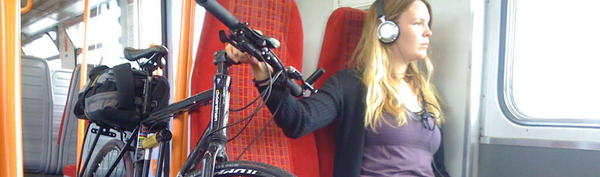
Believe it or not, you can sometimes take your bike on the tube. The older 'sub-surface' lines (Circle, District, Metropolitan, Hammersmith & City) permit the carriage of bicycles. They're forbidden on other tubes, except for the above-ground stretches at the end of the lines.
In any case, bikes are banned at rush hour (7.30-9.30am and 4-7pm). Folding bikes are permitted throughout the network at all times, but taking one through central London at rush hour won’t make you popular.
Mainline trains all have space for bikes, but there are outright bans or heavy restrictions at rush hour.
On commuter lines, forget about taking a full-size bike at rush hour (usually trains arriving in the city before 10am, and leaving between 4.30pm and 7pm). At other times, you can often stash your bike in a vestibule. Some trains do have dedicated spaces, indicated by a bike symbol on a carriage door.
On long-distance trains, you’re generally required to book a bike space in advance (do this online using the East Coast website), whether off-peak or rush hour. Policy varies from company to company: First Great Western will let you take your bike without booking if there’s space available, but Virgin always insists on booking.
There's one way to get round the restrictions. Folding bikes are exempt from train restrictions, and can be stashed in the luggage rack or discreetly in the vestibule. Today's models are pleasant and easy to ride round town; once you’re used to the twitchy steering, it's only on steep hills that you'll feel the difference from a full-size bike.
Bear in mind that the largest ‘folders’ are too big for luggage racks, and that a cheap unbranded folding bike is almost always a false economy. Expect to pay at least £500 for a good model and often much more, but note that Brompton offer sizeable discounts to London Cycling Campaign members.
Bikes have been banned on the DLR since its inception, but in July 2013, the regulations were changed (for a “trial period”). They’re now allowed outside peak hours, with a maximum of two bikes per set of doors.
There are cycle routes to Heathrow and Gatwick, but they’re both a dismal slog through suburbia. So unless you live nearby, we’d reluctantly advise catching the train.
From the city centre, it'll take you a good few hours to wend through London's suburbs on your way to the countryside. You might be lucky and find a nearby traffic-free route such as the Wandle Trail or the River Lee towpath; more likely, your choice will be between quiet and indirect residential roads, and fast but busy arterials. The Avenue Verte (to Paris) and the London-Brighton run might sound enticing, but the posters never boast about the time you spend negotiating Croydon.
Here’s where the trains come in; the countryside is only as far as your nearest mainline station. An afternoon in Kent? Head to Victoria. The Cotswolds? Just turn up at Paddington. You can even get to the Chilterns by tube (Chesham and Amersham are on the Met).
Cycling is a way of life for many Londoners – such as the bike couriers you'll see weaving their way through City traffic at frankly implausible speeds.
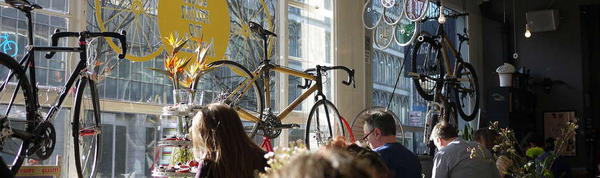
Much though we live and breathe the gospel about sustainability, liveable cities and street space, we’ll admit that London’s new-found love for cycle cafés is quite the most fun part about the city’s bike boom.
Quite why bikes, coffee and cake go so well together we couldn’t say. But they do: try the relaxed canalside Lock 7, the perpetually fashionable Rapha Cycle Club, or the all-encompassing Look Mum No Hands for starters. Some cycle cafés are essentially bike shops which serve coffee; others aren’t really cycle cafés as such, just coffee shops that have been colonised by cyclists. Some attract seasoned Tour-watchers, others are meeting points for bike couriers; some have climbing skills seminars, others knitting evenings. But none will turn you away even if you arrive on a Boris bike or a battered old hybrid. We’re all cyclists, after all.
Bike jumbles, usually staged out in the suburbs, combine second-hand kit with cycling artisans' stalls and, often, a selection of gorgeous hand-made bikes. Herne Hill Velodrome hosts the best-known London event, recently joined by a monthly jumble at the London Bike Kitchen in Hackney. There are more, but publicity is sporadic to say the least. Check out bikejumbles.co.uk and the London Cycling Campaign’s calendar for listings.
Fed up of cycling solo? LCC local groups organise regular, gently-paced social rides, and there’s always the CTC and British Cycling’s member clubs for the faster cyclist. Perhaps the most uplifting experience is joining a campaign ride, organised occasionally to fight for better cycling conditions in London: check out cycle.travel’s news pages for information about upcoming events. There’s also a monthly Critical Mass ride, starting under Waterloo Bridge (South Bank) at 6pm on the last Friday of the month.
Cycling in London wins out over driving on pretty much every count, but none more than parking. Residents’ permits, dank underground caverns, awkward reverses… all a thing of the past.
If you keep your bike inside, ask your local bike shop for wall-mounted or ceiling-mounted racks to save on space. You’ll be taking your bike out 300+ times a year, so buy something convenient, not just clever. If you’re lucky enough to have an outside yard or shed, then don’t skimp on security: thieves know about these, and will think nothing of scaling a wall to steal the bike on the other side.
London has so many commuter cyclists that major employers compete to be cycle-friendly. Secure bike parking is an absolute minimum; many also provide workplace showers and lockers for your pannier or backpack. Good employers will also take part in the ‘Cycle to Work’ scheme, where you can buy a bike tax-free (up to a maximum of £1,000).
Most importantly, a cycle-friendly employer won’t blink if you choose to cycle to a meeting rather than taking the tube, or you’re 15 minutes late due to an unexpected puncture. (After all, they really don’t want to rent a car parking space for you.) Weigh up the facilities when applying for jobs.
Birmingham may have more miles of canal than London, but the capital’s towpaths are still popular cycling routes. The Regent’s Canal runs from Limehouse to Paddington, continuing to Southall as the Grand Union Paddington Arm. The Grand Union itself runs from the Thames at Brentford north towards Watford, and the canalised River Lee heads north from Limehouse towards Tottenham and Enfield.
Canal paths are great places to gather your confidence for a first-time commute, and by all means use them if you're not in a hurry. The Canal & River Trust (formerly British Waterways) is improving the towpaths where it can, but at heart these are narrow, shared-use routes. In central London, they can be congested, especially the east-west Regent’s Canal at rush hour. Further out, the towpath is often unsurfaced and bumpy. So if fast cycling is your bag, we'd recommend you stick to the roads.
You no longer need to download a permit for canal cycling, but the Canal & River Trust asks you to ring your bell and slow down for pedestrians: as the Two Tings campaign would have it, “ting twice, be nice”. Watch out, too, for boaters stepping on and off their craft.
You can’t cycle the whole of the Thames Path in London, but there are several opportunities for traffic-free riverside cycling.
National Cycle Network route 4 largely follows the river. More on-road than off, it leads you out to the west along pleasant backstreets.
In Central London, the south bank is invariably crammed with pedestrians and as such not suitable for cycling, while the Embankment (north bank) is a busy road. You can approach the riverside at Tate Modern and largely continue parallel to the south bank east from there, from where the roads of Wapping, Limehouse and Rotherhithe will keep you close to the shore. There’s rarely a continuous riverside path, however. From Greenwich onwards, you can follow the south bank all the way to Dartford with the occasional interruption.
But the best riverside cycling is in West London. Join the south bank at Putney and follow it all the way to Weybridge, with a brief stretch on the north bank after Kingston. This is almost entirely off-road, well signposted as part of NCN 4, and pubs and cafés are plentiful. It’s perhaps the finest traffic-free cycling experience in London.
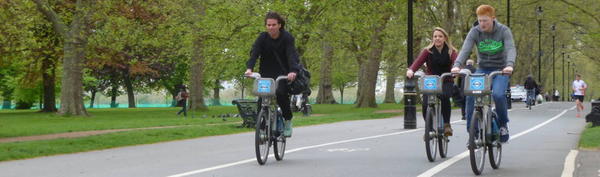
Cycling is allowed on certain routes in the capital’s parks, adding up to 60 miles in all. Half of these are shared-use paths, the other half are roads. The latter have less traffic than other London roads, though we’re not quite sure why taxis are allowed into Hyde Park at all!
Still, these routes can be a godsend. Cycling past Speaker’s Corner in Hyde Park, for example, is infinitely preferable to negotiating Marble Arch and Park Lane. The paths tend to be busy with pedestrians who don’t always notice the white line marking out their space, so don’t expect to go too fast.
Cycling isn’t permitted throughout the parks, just on the roads and a few selected paths. You can be fined up to £200 if you’re spotted on a footpath, so watch out for ‘No Cycling’ stencilled on the entrance to paths. You can also be fined for cycling faster than 10mph in the Royal Parks (20mph in Richmond Park, Greenwich Park and Bushy Park).
As an organisation, the Royal Parks are lagging behind the rest of London in their attitude to cycling, and have expressed some opposition to Boris Johnson’s plans for new routes.
London doesn’t have many of the traffic-free cycle trails that Sustrans specialises in building. (This is partly because few London railways have closed, which of course is good news!)
The best-known, in East London, is simply called the Greenway. It follows the embankment under which the Northern Outfall Sewer is buried, from Bow eastwards to Beckton via Stratford and West Ham. There’s a useful link with the River Lee towpath at the western end.
The 12-mile Wandle Trail heads south from the Thames through Wandsworth to Croydon, while the 8-mile Waterlink Way runs from the Cutty Sark at Greenwich to New Beckenham. They piece together park paths, riverside cycleways and short sections of road. Their piecemeal nature makes them better for unhurried leisure cycling, and do watch out for the frequent gates on the Wandle Trail.
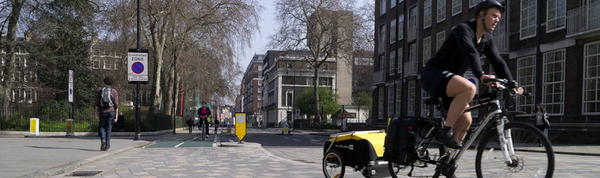
The canny London cyclist will plan a route that follows residential streets where possible, rather than the busy thoroughfares favoured by buses and lorries. Unless you’re a fixie-toting bike messenger, the safer streets more than make up for any extra mileage.
Hackney, Camden, and even the City of London itself have embarked on programmes to stop residential streets turning into rat-runs. These ‘tamed’ roads now make for some of the best cycling in London.
The first tactic is turning through roads into cul-de-sacs for cars. Bollards prevent motorists from driving through, but cyclists and pedestrians can still get past.
Similar to this is the cycle contraflow. This is where a road is one-way for motorists, but two-way for cyclists.
You won’t find these marked on the motorist-centric A-Z, so check with a proper cycle map or route-planner. Unfortunately, it’s rare that you can put together a whole route from these calmed roads, especially when you need to cross an obstacle such as the River Thames or the North Circular Road.
A few bollards don’t make an Amsterdam, of course. Junctions are dangerous just the same, and you still have to watch out for manoeuvring cars. There’s also the ever-present ‘door zone’ – the metre-wide strip beside parked cars, where a door could suddenly be opened on you.
Yet it’s the best London has to offer, and explains why Hackney has more cyclists than any UK city bar Cambridge, Oxford and York. Other boroughs (notoriously the cycle-hostile City of Westminster) are far behind, and it’s to be hoped that the Mayor of London’s promised Quietways will go some way in dragging them forward.
Around one in five of the capital’s roads now has a 20mph speed limit, making them more enjoyable for cycling.
Islington, Camden, Southwark and the City of London have all set it as their default speed limit. The outer London boroughs and (as ever) Westminster are still holding out at 30mph or more.
Major roads are controlled by Transport for London, not the boroughs, and these mostly retain their 40mph and 50mph limits for now. However, TfL has suggested that lower limits could be introduced in future.


Made in the Cotswolds. Published by Éditions Système D Ltd.
Log in with your cycle.travel account:
| Password |
Or simply use your account on:
