
Become a supporter
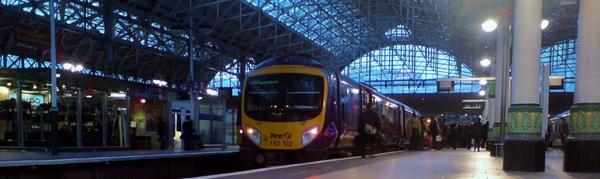
The popular trains from Edinburgh and Glasgow to the Highlands, Aberdeen and Inverness have a good quota of bike spaces, but you’ll need to book them in advance. The same applies to the famous Caledonian Sleeper; most sleepers have six spaces, but some only three. It’s easier in central Scotland, where the commuter trains don’t have dedicated bike spaces; just leave your bike in the vestibules.
Bike spaces on trains between Inverness and Wick/Thurso are often booked up months in advance by Land’s End to John O’Groats cyclists, and many LEJoG riders find it impossible to get a space. If you’re riding to John O’Groats, consider shipping your bike back separately. The Spot bike shop in Wick will do this for you (01955 602698, [email protected]), as will John O’Groats Bike Transport.
One nice touch on ScotRail is Cycle Rescue, a free call-out service for cyclists if you have a breakdown or accident on a train-enabled ride. Call 08000 717212 and have your ticket to hand!
And better still: dedicated bike carriages are being introduced on the West Highland route, converted from old single-carriage trains. They’re not in service yet – definitely something to look forward to.
Official page on the ScotRail website.
Local trains in the North of England. Two spaces on every train, and no need to book. Conductors are encouraged to use their discretion, particularly on busy lines like the Cumbrian Coast (which gets you to the start of the C2C), so you might be lucky even if there’s already two bikes on board – or more! The company meets with cyclists regularly to discuss provision, which we think is unique.
Official page on the Northern website.
Local trains around Liverpool. Bikes are fine at any time, though not recommended at peak times. Particularly useful for crossing the Mersey, as cycling is banned in the road tunnels.
Useful services across the North, connecting with many popular cycle routes. The number of spaces per train varies: TransPennine has a confusing array of different train designs. Booking is now required, though you may see people informally loading bikes into the vestibules for short hops in cities – don’t count on it for a longer journey.
Official page on the TransPennine Express website.
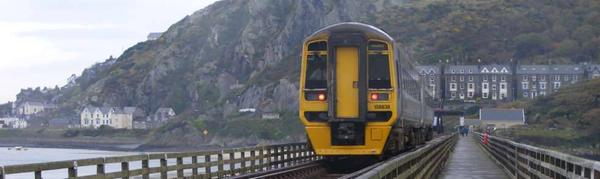
Runs all services in Wales and the Marches except those bound for London. After many years of neglect, new trains are finally being bought for this railway but they’ll take a while to bed in. Until then, almost all their trains are little two/three-carriage units with limited bike space. In particular, the Marches line (Cardiff–Shrewsbury–Manchester and North Wales) and the North Wales Coast line are invariably overloaded and you’d be mad not to book. They have two bike spaces in the centre, but we’ve often found them stuffed with suitcases, especially on trains from Manchester Airport.
Official page on the TfW website.
The ‘other’ route from London to Birmingham, from Marylebone via Banbury. Generally cheaper than Avanti, and one of Britain’s best-regarded companies. Most trains are comfortable commuter units where you can just use the vestibules. They now have a few luxury ‘Silver’ trains with a separate spacious bike compartment in the engine at one end: ask staff for help. No booking required.
Official page on the Chiltern Railways website.
Two arms of the same company, one running local trains in the West Midlands, the other to London and the North-West. No booking required; some trains have a couple of spaces in the centre, or you can unofficially use the vestibules. Their services can be a good (and cheap) alternative to the hassle of booking with Avanti.
Official pages on the West Midlands Railway and London Northwestern websites.
See InterCity page.
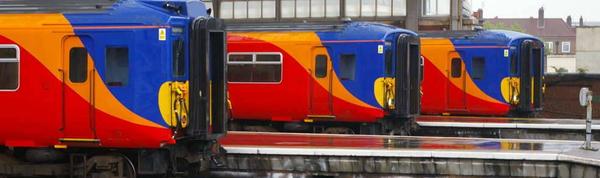
The rule about ‘no bikes at rush hour’ applies particularly here. Don’t expect to take your bike on any train in the weekday or evening peak, even if you’re getting on and off before London. On suburban trains, make sure you keep your bike within sight – frequent stops are manna to the bike thief.
Commuter trains crossing London from north to south, plus the busy Cambridge line. Rush-hour restrictions are strictly enforced around London – these are some of the most overcrowded trains in the country, after all. There are restrictions in the morning peak around Cambridge, too, but otherwise they generally don’t apply north of Luton or Stevenage. Look for a bike symbol on the carriages which points to a storage area.
Official page on the Great Northern website.
Kent and Sussex. SouthEastern’s standard commuter trains have the usual peak restrictions, but these are lifted if you’re travelling in rural Kent and East Sussex without going into London. The company also operates the high-speed trains from St Pancras to Kent, and happily, no special restrictions apply: there are bike spaces at the end (look for the symbol), but in practice the friendly conductors rarely object to bikes being stashed in the vestibules. SouthEastern station staff were at one time notorious for insisting that folding bikes were folded up before going onto the platform; this has in theory been relaxed but don’t be surprised if you’re still asked.
Official page on the SouthEastern website.
Commuter trains in the ’south central’ belt between London and Brighton. A famously sniffy cycle policy, with the most draconian restrictions on folding bikes anywhere in the network: they must be folded before entering the platform, and they prefer “small wheels and folds in more than one place to become roughly the size of a briefcase” (in other words, a Brompton), though they do say they tolerate larger folders “at present”.
Peak restrictions don’t apply in the more rural parts of their network, or against the commuter flow: check the map on their website. (Incidentally, bike spaces are heavily locked down for the annual London–Brighton ride in June, so check your travel doesn’t coincide with that.)
Official page on the Southern website.
South-West London, Hampshire and beyond. Reasonable on-train accommodation on most trains, including commuter routes and those to the South Coast. No booking is required (or available) for these. The usual peak restrictions on peak trains to/from London: check SWR’s map. The bike spaces can and do fill up quickly on sunny weekends in popular locations like the New Forest, so don’t leave it to the last train of the night – give yourself options.
The diesel trains from London via Basingstoke to Salisbury and Exeter have very limited space and booking is essential.
Official page on the South Western Railway website.
The London, Tilbury & Southend line. Modern trains with plenty of space to just load your bike aboard; no booking. Ludicrously, they say that “Folding cycles should be transported in a protective carrying case.”
Official page on the C2C website.
Bikes carried without reservation. Limited space, so don’t catch the last possible train before your flight.
Northern Essex, parts of Cambridgeshire, Norfolk and Suffolk. Run by the Dutch national railway, Greater Anglia is a bike-friendly company running trains throughout East Anglia. Local trains have four spaces each (twice as much as many others), with no booking.
The London–Norwich line takes six bikes in the guard’s van; booking is required in theory but rarely checked in practice. Bikes aren’t allowed on the Stansted Express service.
Official page on the Greater Anglia website.
Yes, you can take your bike on the tube – or some of it! The older ‘sub-surface’ lines (that is, those just below street level) take bikes: the District, Circle and Hammersmith & City, plus the Metropolitan. Bikes are also allowed on the above-ground parts of other lines. Needless to say, no bikes at rush hour.
Similar to the Tube: you can take your bike on the above-ground lines (though not at rush hour), including the services out to Heathrow. But when the underground section finally opens, bikes won’t be allowed on this.
No problem with bikes off-peak. There’s a maximum of one folding bike per vestibule.
Bikes are (finally!) now allowed on the DLR, except at rush hour.
Official page for Underground, Overground and DLR on the TfL website.
For trains on the inter-city lines out of Paddington (to Reading and Oxford), Kings Cross (to Stevenage and Peterborough), and St Pancras (to Bedford) see our guide to inter-city services. For trains towards Aylesbury and the Chilterns, and stopping trains from Euston towards Milton Keynes, Coventry and Birmingham, see our guide to Midlands trains.
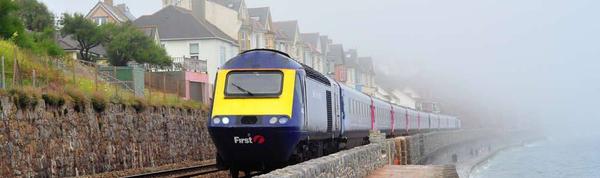
Trains from London Euston to Birmingham, the North-West and Scotland. Booking is compulsory; if you arrive at the station without one, you may be able to book at the ticket office, but don’t count on it. Most trains are tilting ‘Pendolinos’ with a bike compartment at the country end. The door can only be operated by staff: get help from platform staff before boarding, and (crucially) find the conductor once you’re on the train and tell him where you’re getting off. A few trains north from Birmingham are five-carriage Voyagers with an easily accessible bike compartment at one end, and though these are less hassle, we’d recommend booking here too.
Official page on the Avanti website.
Runs long-distance services that don’t pass through London, so their trains should be really useful to the cyclist. Would that were true…
Most of CrossCountry’s trains are four/five-coach ‘Voyagers’ with a tiny bike space in the middle: two reservable hanging spaces, one unreservable space. Making reservations is pretty much essential. (If you’re caught out, you can surreptitiously fit a bike in the super-generous luggage space just beyond, but we didn’t tell you that.) Their medium-distance Midlands services, from Birmingham to Nottingham, Cardiff, Leicester and Cambridge, are just local trains with a free-form bike space in the middle, and in practice you don’t need to reserve on these.
Official page on the CrossCountry website.
Long-distance trains from London King’s Cross to Leeds, the North-East and Scotland. Dedicated space in a guard’s van, for which booking is required: ask the staff where to load your bike, because both ends of the train are used. LNER station staff can be sticklers for regulations where cyclists are concerned; book, arrive in plenty of time, and don’t give them any excuses to refuse you.
Official page on the LNER website.
An alternative to East Coast if you’re heading to York or the North-East, and one of the best-kept secrets of the railways. Lots of bike space at each end of the train, and no need to book, though as ever we’d recommend it if it’s crucial to your holiday. They even sell special cycle-rail holidays around Yorkshire – how enlightened is that?
Official page on the Grand Central website.
Trains from London to Selby and Hull. Four bike spaces in theory, but we think you could manage six in practice. Booking is preferred though not always necessary.
Oh, GWR, where did it all go wrong?
Runs trains out of London Paddington to the Thames Valley, Cotswolds, West of England and South Wales, plus local trains in those areas. A few years ago their bike provision was exemplary. Now… it’s pretty terrible.
New Intercity Express Trains are being introduced which only have two bike spaces per five-coach train. (Or rather, they have four, but GWR are only allowing two to be used.) Advance booking is compulsory.
On Thames Valley commuter services the situation is brighter: you can carefully stash your bikes in the vestibules, or sometimes a two-bike compartment in the centre carriage. Local trains in the West have limited space and are first-come, first-served, but the conductors are usually friendly and helpful. Many of these services are now using cast-off Turbo trains from the Thames Valley which have more vestibule space.
Official page on the Great Western Railway website.
From London to Leicester, Derby, Nottingham and Sheffield, plus local trains around the East Midlands. You need to book for the London mainline and for the Liverpool–Nottingham–Norwich route, and in theory there’s only two bike spaces per train, which is pretty miserly.
However, some of the London trains are High Speed Trains with more spaces. The Liverpool–Norwich services are also sometimes formed of two units coupled together, so four spaces in all. You won’t be able to book these extra spaces, but the staff are less fussy than LNER (say) or CrossCountry, so you might be lucky. On London trains, the bike space is at the country end of the train. Folding bikes are, on paper at least, meant to be stored in the luggage racks.
On local trains, you can just load the bike and hop on. Space is again limited to two per train, though we’ve sometimes seen more even on EMR’s tiny little single-carriage trains.
Official page on the East Midlands Railway website.
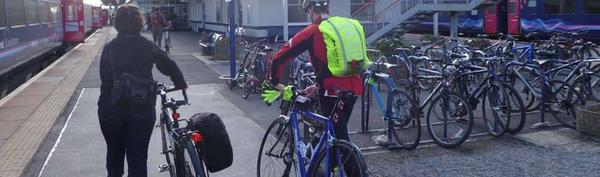
If you’re at a staffed station, ask where to load your bike – a few minutes in advance, if you can. If not, look for a bike sign on the platform, or the bike symbol on a door as the train pulls in.
On most trains, the bike spaces are just in the normal carriages. On newer InterCity trains, this is generally in a separate compartment near one of the doors. On Virgin’s tilting Pendolinos, the bike storage has its own door, but once you’re in you can walk through to the carriage. On older InterCity trains, you’ll need to load your bike into a ‘guard’s van’, then jump back out onto the platform and go in via a passenger door.
It might be a hassle, but an unloaded bike takes up much less space than a loaded one. Removing panniers enables another cyclist to load their bike next to yours. (If the guard’s van is separate, do this on the platform, and pick them up when you go back into the carriage.) You might want to remove expensive lights, too.
Locking the bike to the train is expressly forbidden, just in case you can’t get it unlocked again. If your bike’s in a guard’s van, though, these are generally pretty secure.
Your booking will have been accompanied with a vast array of tickets, including one labelled ‘Attach to bike’. We’re unconvinced by these; they tell potential thieves how much time they have to half-inch your bike. We’ve never been chastised for not affixing one, but if you do choose to use it, we suggest blacking out the destination.
Train companies are fined heavily for every minute they’re late, and timetables are tight. Cyclists causing delays will mean a bad reception for the next bike-toting passenger, and worse bike provision in the future. So don’t hang around; be efficient, and be seen to be efficient. Strolling idly along the platform will annoy the conductor.
When the conductor comes to check your tickets, tell him/her you’ve got a bike, where it is, and where you’re getting off.
On many trains, passengers will be brushing up against your bike. They won’t thank you for mud or oil stains on their new suit.


Made in the Cotswolds. Published by Éditions Système D Ltd.
Log in with your cycle.travel account:
| Password |
Or simply use your account on:
